The Museum of the Medici Chapels in Florence
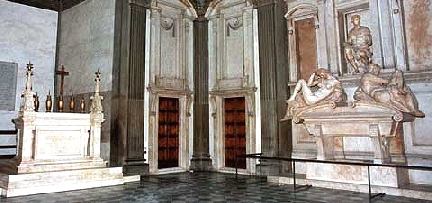
Florence - Medici Chapels
The Medici Chapels form part of a monumental complex developed over almost two centuries in close connection with the adjoining church of S. Lorenzo, considered the "official" church of the Medici, who chose it at the time they lived in the neighbouring palace ol Via Larga (now Medici-Riccardi Palace). The decision to build their mausoleum in this church dates back to the 14th century (Giovanni di Bicci and his wife Piccarda were for instance buried in the Old Sacristy, built on a project of Brunelleschi). The project of building a proper family mausoleum was conceived in 1520, `when Michelangelo started working at the New Sacristy upon request ot Cardinal Giulio de` Medici, the future Pope Clemens VII, who expressed the desire to erect a mausoleum on behalf of some members of his family: Lorenzo the Magnificent and his brother Giuhano, Lorenzo Duke of Urbino and Giuliano, Duke of Nemours. After completing the architectural works in 1524, Michelangelo worked until 1533 on the sculptures that would have decorated the walls and the very original sarcophagi. The only ones actually completed were the statues of Lorenzo Duke of Urbino and of Guduino Duke of Nemours, in addition to the allegories of Day and Night, Dawn and Dusk, and the group representing the Madonna with Child flanked by Saint Cosma and Damian (protectors of the Medici), executed respectively by Montorsoli and Baccio da Montelupo, both pupils of Buonarroti. The solid and articulated architectural structure and the strength of Michelangelo`s sculptures clearly reflect a complex symbolism that offers an interpretation of Human Life where active and contemplative life interact to free the soul after death, following a philosophical concept that was closely linked with Michelangelo`s spirituality. Numerous drawings by Michelangelo were found in a small space beneath the apse. They had been drawn, as often occurred, by the artist and may be related to the statues and architecture of the Sacristy.
Cappella dei Principi
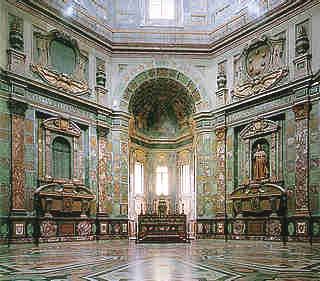
Chapel of the Princes
This Chapel is yet another grandiose and pompous mausoleum erected between 1604 and 1640 by the architect Matteo Nigetti to the designs of Giovanni de` Medici, a member of the family who practised architecture in a semi-professional manner. The Mausoleum was conceived to celebrate, with its large dome and lavish interior decorated with marbles, the power of the Medici dynasty, which had safely been ruling Florence for several centuries. The octagonal room designed to receive the bodies of the grand dukes is in fact almost entirely decorated with semi-precious stones and marbles. The grand ducal sarcophagi are completed with bronze statues and inserted in niches. The inlay of the semiprecious stones, partially executed by the extremely skilled workers employed in the laboratories of the Opificio delle Pietre dure (see the related section) took several centuries to be completed due to the difficulty of finding these materials, available only at a very high cost. The dome should have originally had an internal coating of lapis lazuli but was left incomplete at the end of the Medici period and frescoed in 1828 by Pietro Benvenuti with scenes of the New and Old Testament at command of the reigning Lorraine family ..... from `Museums and Galleries of Florence and surroundings` ( Apt - Florence )
Medici Chapels ... More Information ..
Medici Chapels
Our most requested apartments in the Florence historical centre:
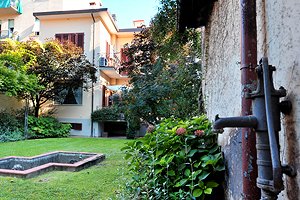 Holiday apartments in pretty villa on the southern outskirts of Florence, in the vicinity of Piazzale Michelangelo. Accommodation for groups of 4/6/8/10/12 people. Air conditioning, Internet connection. Just a few minutes from Florence historical centre.
More details
Holiday apartments in pretty villa on the southern outskirts of Florence, in the vicinity of Piazzale Michelangelo. Accommodation for groups of 4/6/8/10/12 people. Air conditioning, Internet connection. Just a few minutes from Florence historical centre.
More details
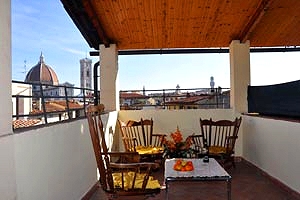 Beautiful apartment sleeping 6+2 in Florence historic centre, at a stone`s throw from Santa Maria Novella railway station. Air conditioning, Internet connection and panoramic balcony with view over the Duomo and the Medici Chapels.
More details
Beautiful apartment sleeping 6+2 in Florence historic centre, at a stone`s throw from Santa Maria Novella railway station. Air conditioning, Internet connection and panoramic balcony with view over the Duomo and the Medici Chapels.
More details
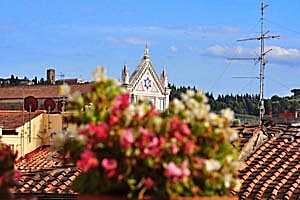 Apartment sleeping 2+1 in the heart of Florence historic centre, in the district of Santa Croce. Panoramic balcony with view over the basilica of Santa Croce, air conditioning, Internet connection, close to the most important Florentine monuments.
More details
Apartment sleeping 2+1 in the heart of Florence historic centre, in the district of Santa Croce. Panoramic balcony with view over the basilica of Santa Croce, air conditioning, Internet connection, close to the most important Florentine monuments.
More details
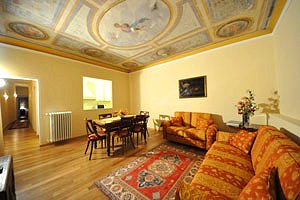 Apartment in the historical centre of Florence a few steps away from the Accademia Gallery. Nearby Piazza Duomo, Piazza Signoria, the Uffizi Gallery . 5+2 beds, Internet Connection and air conditioning.
More details
Apartment in the historical centre of Florence a few steps away from the Accademia Gallery. Nearby Piazza Duomo, Piazza Signoria, the Uffizi Gallery . 5+2 beds, Internet Connection and air conditioning.
More details