Boboli Gardens in the Center of Florence
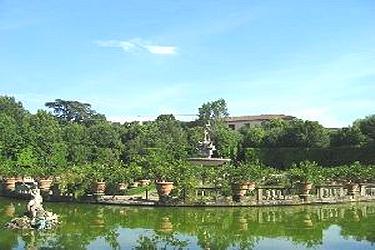
Boboli Gardens
The Garden that extends from the hill behind the. Pitti Palace as far as Porta Romana, reached its current extension and appearance, becoming one of the largest and most elegant Italian style gardens, through several stages of enlargement and restructuring work carried out at different times. The first works initially affected the area that was closer to the palace, after the building had been purchased by Cosimo I de` Medici and by his wife Eleonora di Toledo, who had chosen this place for new grand ducal palace. The initial plan was drawn by Niccolo Tribolo, although the works were completed, after his death in 1550 by other architects including also Giorgio Vasari (from 1554 to 1561) along with Bartolomeo Ammannati and Bernardo Buontalenti under the reign of Francis I, who succeeded to his father Cosimo. The Medici and the Lorraine families continued to enrich and enlarge the garden also in the 17th, 18th and 19th centuries. Besides adding lovely meadows, avenues, small groves and beautiful panoramic views, they made the garden more precious by including extraordinary decorative complexes, thus forming an outdoor museum that exhibited both Roman and 16th and 17th century statues. The first phase led to the creation of an Amphitheatre adjoined to the hill behind the palace. The early amphitheatre, initially formed by "edges and evergreen meadows", was later replaced by a stone one decorated with statutes based on Roman myths such as the Fountain of the Ocean sculptured by Giambologna, then transferred to another location within the same garden, the small Grotto of Madama, and the Large Grotto, `which was begun by Vasari and ended by Ammannati and Buontalenti between 1583 and 1593. Despite the fact that it is currently undergoing complex restoration work (1998) due to the damages suffered over centuries these statues continue to be remarkable examples of Mannerism architecture and culture. Decorated internally and externally with stalatites and originally equipped with `water plays and a luxuriant vegetation, the fountain is divided into three mam sections.
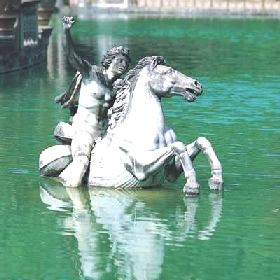
Boboli Gardens - Giambologna
The first one was frescoed to create the illusion of a natural grotto, that is a natural refuge to allow shepherds to protect themselves from wild animals, and originally housed the Prigionieri of Michelangelo, which were moved to this location after they had become part of the Medici collection (the original statues have now been replaced by copies). The rooms that follow exhibit valuable sculptures like The Bathing Venus of Giambologna and the group of Paris and Hellen of Vincenzo de Rossi. Other fine works are also situated in the area above the amphitheatre. This is the location of the fountain known as the Fountain of the "Fork" or Neptune`s fountain, named after the sculpture by Stoldo Lorenzi located in the middle of the fountain that appears to be holding a large trident. In the park we also find the large statues of the Abundance, located on the top of the hill, started by Giambologna, to represent Giovanna of Austria, the wife of Francis I. The statue was actually ended in 1637 as allegorical figure. Walking through the garden towards Porta Romana, after the so-called Prato dell`Uccellare, we find the Viottolone, a large avenue flanked by cypresses and statues that leads to the open space of the Isolotto, begun by Giulio and Alfonso Parigi in 1618. In the centre of the space, you can admire the fountain of the Ocean by Giambologna surrounded by other three sculptures representing the rivers Nile, Ganqe and Euphrates. All around there are other statues based on classic and popular subjects (belonging to the 17th and 18th centuries) like those that show groups of children playing traditional games. The House of Lorraine made further additions m the 18th century, such as the Kaffeehaus (1775), the Lemon House (1777-8), both built by Zanobi del Rosso and the Palazzina della Meridiana begun in 1776 by Gaspero Paoletti. The Egyptian Obelisk brought from Luxor was placed in this location in 1789 ..... from Museums and Galleries of Florence and surroundings ( Apt - Florence )
Boboli Garden ... More information ..
Boboli Garden
Our most requested apartments in the Florence historical centre:
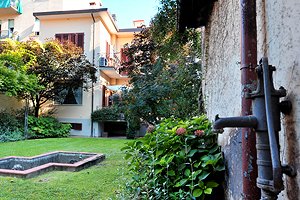 Holiday apartments in pretty villa on the southern outskirts of Florence, in the vicinity of Piazzale Michelangelo. Accommodation for groups of 4/6/8/10/12 people. Air conditioning, Internet connection. Just a few minutes from Florence historical centre.
More details
Holiday apartments in pretty villa on the southern outskirts of Florence, in the vicinity of Piazzale Michelangelo. Accommodation for groups of 4/6/8/10/12 people. Air conditioning, Internet connection. Just a few minutes from Florence historical centre.
More details
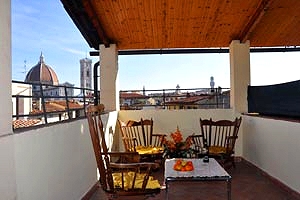 Beautiful apartment sleeping 6+2 in Florence historic centre, at a stone`s throw from Santa Maria Novella railway station. Air conditioning, Internet connection and panoramic balcony with view over the Duomo and the Medici Chapels.
More details
Beautiful apartment sleeping 6+2 in Florence historic centre, at a stone`s throw from Santa Maria Novella railway station. Air conditioning, Internet connection and panoramic balcony with view over the Duomo and the Medici Chapels.
More details
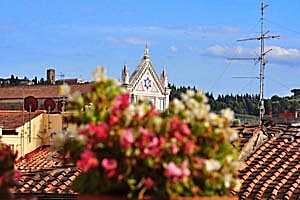 Apartment sleeping 2+1 in the heart of Florence historic centre, in the district of Santa Croce. Panoramic balcony with view over the basilica of Santa Croce, air conditioning, Internet connection, close to the most important Florentine monuments.
More details
Apartment sleeping 2+1 in the heart of Florence historic centre, in the district of Santa Croce. Panoramic balcony with view over the basilica of Santa Croce, air conditioning, Internet connection, close to the most important Florentine monuments.
More details
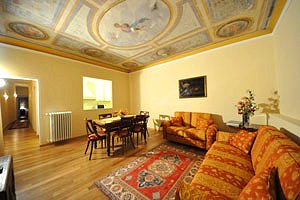 Apartment in the historical centre of Florence a few steps away from the Accademia Gallery. Nearby Piazza Duomo, Piazza Signoria, the Uffizi Gallery . 5+2 beds, Internet Connection and air conditioning.
More details
Apartment in the historical centre of Florence a few steps away from the Accademia Gallery. Nearby Piazza Duomo, Piazza Signoria, the Uffizi Gallery . 5+2 beds, Internet Connection and air conditioning.
More details